

Managing risks during pandemic driven chaos

Whenever markets crash due to events such as the current Coronavirus pandemic that triggers major macroeconomic shock, it becomes difficult for various asset management firms, hedge funds, brokerage firms and other financial institutions to manage their risks. A typical market crash is characterized by a drop in the value of the whole market by 10% or more within a few days. This could be attributed to panic selling of various financial assets such as stocks, bonds etc. Risk Management – market risk, operational risk, credit risk etc are primary concerns for financial firms in such stressed market conditions. In this type of market situation, systems are also stressed beyond normal and established processes are affected. Ironically “the risks in the risk management function” are exposed in these conditions.

Experts in most firms who are very much needed to manage the situation have been dislocated from their offices in this pandemic escalation. Communication has become a huge challenge. Most firms are not geared to handle this extreme event, unprecedented in our lifetimes. Chances of errors are bound to increase by leaps and bounds when such chaos is in play. Existing systems use predetermined rules that work great for established processes. When established processes cannot be used and improvisation is needed, this can introduce errors that could be a costly affair for the firm. In addition, adding new rules can take time and there may be limited time to test the impact of these rules.

AI could possibly provide solutions to these firms in these situations.

  • AI is nothing but an amalgamation of algorithms that help a system to learn by itself based on the data fed to the system. AI models need to be designed to adapt quickly to changing market conditions such as increased volatility, increased volume of trades, decreased size of each transaction, changing trading patterns within the clients, traders etc.
  • These AI models should not be frozen in time but should adapt quickly and still spot anomalous risk exposures even within the abruptly changed market dynamics. AI can’t provide 100% prediction that the market would crash due to an overnight event but AI can help organizations spot areas of exposures and assess the efficacy of their existing risk models and compliance policies in the wake of these events and help organizations to redefine/refine the processes.
  • With the help of AI, firms can manage their risks and create a risk model that could save them from going bankrupt in the wake of such events happening overnight. Even if the firms survive such crashes their existing models can expose the risks they pose and can cause the firms billions of dollars across the globe. This could be rectified if solutions powered by AI, even if it serves as a 2nd line of defense in the short term, are in place. This is just one use-case of AI.
  • There are several use-cases of AI that could be applied in the financial markets. AI has been implemented to study the 1987 market crash and a few other scenarios where markets crashed a whopping 10+%. Most of them have pinpointed sudden anomalies appearing in the data before the crash. These key anomalies appeared in organizational risk models which firms developed prior to the crash indicating that the system would not survive the crash.
  • There are several case studies available where AI has been back-tested on data of previous market crashes. In 2019, the Finra annual report found that there were inadequate limit controls of various member firms. This would be even more pronounced in stressed conditions like now.

    EagleAI™ is a solution powered by AI, ML and neural network algorithms from an expert team at Quantel that helps firms to build effective risk and compliance management systems. EagleAI™ helps firms to catch issues that were not even known to exist. Check out this Trading Risk Use Case.

    Why Eagle AI™?
  • EagleAi™ is not based on rules and adapts as data patterns change.
  • EagleAi™ can recognize unexpected patterns and highlight potential errors.
  • Unexpected conditions can impact your business. EagleAi™ can help minimize the pain.
  • EagleAi™ represents a new era of intercepting anomalies.
  • It uses advanced AI/ML algorithms for market/trade surveillance.
  • Helps to check potential risk flags and reset the same.
  • Can work on any type of data whether structured or unstructured data.

    If you are looking to bolster your existing systems, EagleAI™ presents itself as a great solution. EagleAi™ offers flexible architecture and can be integrated with the existing systems completely seamlessly both on-premise as well as on cloud. It can do anomaly detection on batch data or on streaming real-time data. With its plug-in architecture, this product can be easily integrated with upstream and downstream systems and can adapt to any data format. Experts in Risk Management domain along with Data Scientists at Quantel AI have designed AI models that checks for Compliance rules across various financial markets. EagleAI™ comes with an array of Risk exposure models and Fraud detection models for Trading environments as pre-built tool boxes that can be snapped onto EagleAi™ as plugin extensions. Due to its seamless architecture that requires no integration with existing systems other than access to log files or database, EagleAi™ can go-live within weeks – providing a treasure trove of analytical insights along with hot spots of previously unknown/ignored risks. Dedicated teams from Quantel AI work with the clients all the way from a POC to a go-live.

What’s more, the Risk Managers/CROs can download a daily ‘Risk status’ report from the product to analyze their existing regulatory compliance processes as well as risk models. The product provides risk data for regulatory and compliance submissions as well.If you are interested to get a demo of EagleAI™ and how it can help your firm, please get in touch at info@quantel.ai or call 1-833-EAGLEAI to Book a demo today!

.
Anomaly Detection & EagleAI™

The earliest concepts of Artificial Intelligence date back to the 1950s. However it wasn’t until this past decade that AI has really been able to flourish due to the exponential growth in big data coupled with enhancements in computing power, both of which have helped pave the way for AI systems to be applied to nearly every industry.

In the upcoming years, industry professionals expect the growth of AI to continue. According to market research firm Tractica, annual global revenue of AI software is forecasted to grow from $9.5 billion in 2018, to $118 billion annually by 2025. As we see a rise in annual revenue we can also expect to see a continued growth in the number of ways artificial intelligence is applied to real world problems.

In addition to substantial revenue growth, AI focused organizations have also seen a significant jump in venture capital dollars being invested into AI based endeavors. Since 2013, venture capital investments in AI startups have regularly increased, with a compound annual growth rate of about 36% according to PWC.

Recently one of the most effective ways that computer scientists have been harnessing the power of AI is in the field of Anomaly Detection. As per Wikipedia, “anomaly detection is the identification of rare items, events or observations which raise suspicions by differing significantly from the majority of the data”. These anomalies could either point to a risk lurking in the background or an equally important opportunity that can be tapped for increased profitability.

Anomaly detection and AI are becoming increasingly relevant in the financial services industry with its ever growing types of flows and volume of transactions; as well as the difficulty to detect potentially anomalous transactions using traditional rules based approaches. According to a report published by Boston Consulting Group, since the financial crisis in 2008 financial institutions had paid over $321 billion USD in fines due to an abundance of regulatory fines and failings in risk management including operational oversights causing substantial losses for the firms. Check out this Trading Risk Use Case.

With increased regulatory requirements around effective risk management, firms have been increasing their regulatory technology and 2nd line of defense program budgets. Fintech startups are leading the innovation frontier by solving these problems using AI, rather than by taking traditional rules based approach for detecting such issues. AI models are proving to be more effective in detecting anomalies in financial transactions and user behaviors. A firm’s investment in these advanced technologies pays for itself in very little time with its ability to manage operational risks more efficiently and prevent huge losses. Quantel AI can help firms leap frog competitors with the adoption of such technologies. Here at Quantel AI we have successfully developed our own flagship Risk Management and Anomaly Detection solution called EagleAI™.

The EagleAI™ Anomaly Detector has the ability to detect even the tiniest of ‘needles in a haystack’ by using advanced AI models and data engineering techniques designed to process hundreds of millions transactions a day at an enterprise scale, EagleAI™ is able to observe patterns under different conditions to become an expert at detecting anomalies in real-time. EagleAI‘s models automatically weed out noise and alerts users only on the signals that needs their attention. EagleAI™ gives an organization the ability to get timely alerts on potentially large errors, compliance violations, as well as flagrant user behavior and gives firms the opportunity to fix these problems before they balloon into a significant loss or cause damage to a firms’ reputation. If you are interested to get a demo of EagleAI™ and how it can help your firm, please get in touch at info@quantel.ai or call 917-499-9396 to Book a demo today!

Advanced Risk Management Solutions for Trading Institutions

Artificial intelligence (AI) plays a very important role in Risk Management fraud detection in the finance industry, especially as several big trading firms lose billions of dollars each year to due to compliance and risk management problems.

Machine Learning: This method improves the accuracy of risk models by identifying complex, nonlinear patterns in large data sets. Every bit of new information is used to increase the predictive power of the model. In the world of trading, with the increasing pressure in managing risk along with growing governance and regulatory requirements – it is mandatory for firms to enhance their risk management towards better compliance and in reducing huge losses. Several Leading Risk Management Consulting companies like – Deloitte, CapGemini, IBM, Marsh Risk, PWC, McKinsey, Crowe, KPMG, EY, etc., are working with big financial firms to find ways to provide process improvements and enforce standards and policies to develop highly customized solutions for managing risk and compliance.

Trading firms can leverage the combined power of Traditional validated proven methods of Risk management along with EagleAI’s Advanced Artificial Intelligence and Machine Learning Risk management based predictive big-data analytics – customized to their environment as their second line of defense.

AI Fraud Detection for Market – Data Risk: Artificial Intelligence /  Machine Learning is being used as a solution to detect deviations from sector or market trends, catch abnormal intra-day movements, abnormal options activity before it occurs. This not only serves to protect banks from costly errors but also proactively alerts risk and compliance managers for abnormal or sudden stock price/volume movements to avoid large trading losses. Check out this Market Data Risk Use Case.

AI Fraud Detection for Trade Fraud Risk: AI can help combat and defeat frauds and manipulative trades by detecting illicit activity early in the process. Machine learning Algorithms can detect Spoofing and Layering, Front running, suspicious trader behavior, quote stuffing, wash trades, marking the close etc. to stop financial damage before it occurs. Check out this Fraud Risk Use Case.

AI Fraud Detection for compliance risks: AI monitors Compliance with various global regulatory requirements for banks, detects risks & anomalies and prevents losses due to non-compliances. Algorithms can pull from a variety of data points, from transaction origination to the end destination and more, to identify deviations from normal patterns. This not only serves to protect banks costly errors and proactively alerts risk and compliance managers to avoid costly fines and penalties. Check out this Compliance Risk Use Case.

The earlier the big banks and financial institutions adopt AI/ML advanced solutions for Risk Management the quicker they can mitigate and save billions of dollars. EagleAI’s advanced AI/ML Risk Management does just that – and is designed to detect, and Predict and discover actionable Risks and compliance insights. Check out this Trading Risk Use Case

Find out how EagleAI can bring AI to the banking industry through early detection and actionable results by scheduling a free demo. Book a demo today!

Ways to Implement Enterprise Risk Management using EagleAI

Risk professionals often focus on enterprise risk management (ERM) as a separate entity rather than a means to enhance an organization’s objectives. For Enterprise Risk Management to be successful, it should center on: Adapting to changes and providing value to the organization.

There is fixed process to implement an Enterprise Risk Management program that is 100% efficient. Check out the following guidelines to go about implementing Enterprise Risk Management.

  1. Define the value add from ERM

Whether value is expressed as market share, profit, or managing penalties, fines and reputational damage and how does enterprise risk management improve the organization’s objectives? In other words, what business need will be met through a structured ERM approach?

2. Research and understand different standards and frameworks

If you operate in a regulated environment, you indeed may need to comply with specific risk management standards. Research and find out as much as you can and this will give a solid foundation to decide what elements are the most vital to your ERM initiative. Also, Organizations must integrate Artificial Intelligence and Machine Learning tools to the existing traditional risk management frameworks and processes.

3. Allocate risk owners

Identify and delegate resources that can be held accountable for the risk management plan decisions and execution. This person will likely need to rely on others to make the plan work and manage interconnected risks, but naming an individual risk “owner” will help move the chosen response plan to action. The risk owner should ensure that AI and ML tools and processes are in place to meet the constantly changing rules and compliances.

4. Have Customized real-time Dash-board and Alerts

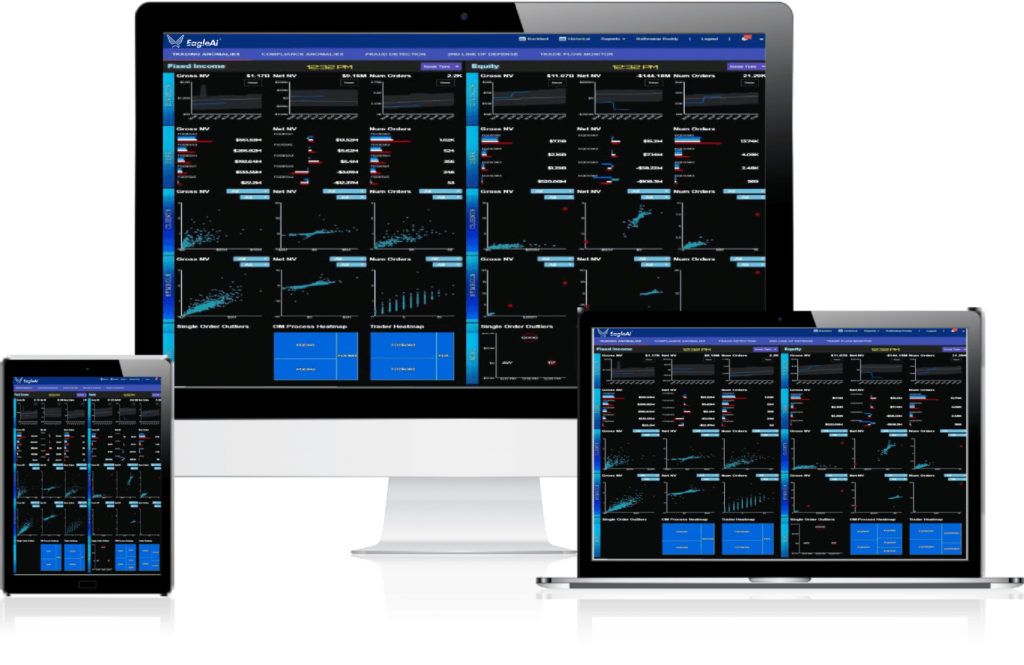
Dash-boards customized reports highlight the executive level summarized data and drill down analytics for enterprise risk management that makes decision making in your organization simpler and faster.  EagleAI Tradewatch dashboard can be helpful in Proactively managing the organization’s risks by alerting on significant anomalies automatically and provide unrivaled market insights on global financial markets along with Workflow integration for follow-up actions on detected issues.

5. Keep it simple

To the Risk and Compliance Mangers, the ERM program mandate is less important than gaining value by making better-informed decisions about risk. While a formal training program may be characteristic of a mature program, simple process training, using EagleAi Tradewatch risk management solution is quite appropriate when combined with traditional risk management process.

Now with EagleAi TradeWatch and its functionally rich modules such as Trading Risk, Market Data Risk, Client Connectivity Risk, Position Risk, Compliance Risk, and Fraud Risk you can identify trading vulnerabilities and breaches before they become a serious liability for your enterprise.

Request a demo today. We can show you how EagleAi, a fully managed service can mitigate your enterprise’s risks at a fraction of cost and could even uncover lurking issues that could surface up to cause major losses.

Understanding Artificial Intelligence and Machine Learning model of Risk Management Process

The standard model of risk management process starts with identifying risks followed with analyzing, prioritizing, resolving, and finally monitoring these risks. With increased regulatory requirements around effective risk management, firms have been increasing their investments in regulatory technology and 2nd line of defense programs. Fin-tech startups are leading the innovation frontier by solving these problems using AI, rather than by taking traditional rules based approach for detecting such issues. AI models are proving to be more effective in detecting anomalies in financial transactions and user behaviors. A firm’s investment in these advanced technologies pays for itself in very little time with its ability to manage operational risks more efficiently and prevent huge losses.

Let’s discuss these in detail as below:

Risk Identification

Identifying  risk areas of an organization in advance helps it to manage its risks in a consistent and transparent manner. If done correctly, a well-defined risk framework will make the process more predictable and helps reduce uncertainty. The initial step is to identify the risks that the business is exposed to in its operating environment. For example in the area of Trading, there are various kinds of risks – Anomalous Trading risks,  Fraud risks, Data Quality risks, Market Exposure risks, Client Connectivity Risks, Regulatory / Compliance risks, etc. It is of utmost importance to identify as many of these risk factors as possible with the help of domain experts in this organization. It is recommended that an organization have a risk management solution automatically update a centralized system. The advantage of this approach is that these categories of risks and the health of risk management across each of the categories can be visible to every stakeholder in the organization. If done correctly, it will make the process more predictable and help reduce uncertainty, financial losses and regulatory fines.

Risk Analysis

After a risk is identified, the next step is to analyze the risk. The Risk scope must be determined and it is imperative to understand the link between the risk and different factors within the organization. There are risks that can bring the whole business to a standstill if that risk event occurs, and there are risks that can cause reputational damages to the firm in front of clients, regulators and common public. Most risk management solutions have different categories of risks, depending on the severity of the risk from low to high. It is important to rank risks of each category because it allows the organization to gain a holistic view of the risk exposure of the whole organization.

When an ideal risk management solution is implemented – it helps in mapping these risks to different documents, policies, procedures, and business processes along with the current health of the risk category. This means that the system will already have a mapped risk framework that will evaluate risks and let you know the far-reaching effects of each risk. Firms often spend far too much time developing disparate systems to support their risk management and still find themselves being charged by regulators of having inadequate internal risk management controls.

Risk Treatment

Risks should be eliminated or contained as much as possible. This is usually done by connecting with the experts of the field to which the risk belongs to. In an ideal risk management solution, all the relevant stakeholders can be sent notifications from within the system as soon as the risk is identified. The discussion regarding the risk and its possible solution can take place from within the system. Ownership can be assigned to individuals. Senior management can get updates directly from within the risk management solution instead of relying on information flow up the chain.

Risk Monitoring and Risk Review

Not all risks can be eliminated – some risks are always present. Market risks and environmental risks are just two examples of risks that always need to be monitored. Risk owners must make sure that they keep a close watch on all risk factors. Under a digital environment, the risk management system monitors the entire risk framework of the organization. Monitoring risks also allows your business to ensure continuity.

Once risks have been identified and assessed, all techniques to manage the risk fall into one or more of these four major categories:

– Avoid (eliminate – withdraw)

– Reduce (optimize – mitigate)

– Share (transfer – outsource)

– Retain (accept and budget)

EagleAI has released an advanced risk management system for detecting trading anomalies like market abuse, fraudulent / manipulative trading, erroneous trading, malfunctioning algorithms and compliance violations. Many of the aspects of a design principles of risk management outlined above can be achieved. EagleAi is designed to be a seamless AI engine that ‘learns patterns by observing the flows’ which helps it to identify a problem as soon as it happens. EagleAi can also be an early warning system as it can see the trend to predict when a breach is expected to happen. EagleAI is built using advanced Self Learning AI/ML integrated with big data analytics with our real-time risk management solution – and ensures that the data in your system is accurate to reduce false positives. Because it is a self-learner, EagleAi can detect even issues that were previously not known to exist and prevent a future issue. EagleAi has integrated its risk modules in popular Enterprise GRC tools such as OpenPages and SeviceNow. EagleAi can be deployed both as an on-prem as well as a cloud hosted solution.

Request a demo today – and we can show you how EagleAi, a fully managed service can mitigate your enterprise’s risks at a fraction of cost and could even uncover lurking issues that could surface up to cause major losses.